Stories
Regaining speech after an electrical injury: One woman's journey toward healing
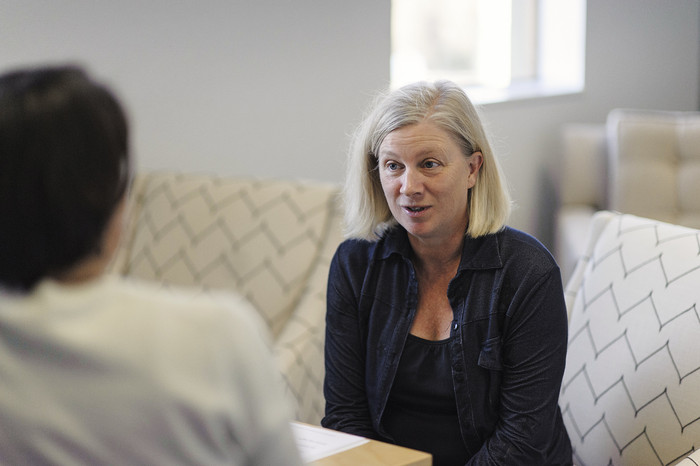
As a 52-year-old mom of three, wife, business owner and avid horseback rider, Ann Marie Strand had little time for rest. Her commitments demanded the very best of her brainpower nearly 24/7.
Until one day in May 2015, when it all came to a sudden halt. In her daily mix of conference calls and school pick-ups, Ann Marie took her daughter to her horseback-riding lesson. As she reached to open a gate at the equestrian center, a faulty electrical system shocked her and left her with a severe electrical injury.
"I remember grabbing the gate, but little else about the six months after that. My brain is like a fog bank and the fog was thick that first six months," she says.
Understandably so. A severe electrical injury like Ann Marie's affects the body similar to a TBI (traumatic brain injury). Both wreck havoc on the central nervous system, and often cause severe vertigo, slowed speech and blurred memory, none of which escaped Ann Marie.
"I still speak slowly," she says. "The first six months were the worst, I had a really hard time speaking and finding the words I wanted to say."
After a TBI, people often lose the ability to filter out unnecessary background noises and sights, called hypersensitivity. This condition turns even the most routine social settings into events that are too overwhelming or frustrating to handle.
"Things like going to a coffee shop and having a conversation are difficult for me … there is just too much there. For the first year I didn't drive, go to the grocery store, lost the ability to read, and it became hard to even look at a computer screen."
Forced to end her business due to the effects of her injury, it was difficult for Ann Marie to stay hopeful. "I've always had my own motor as a self-employed business owner," she says of her internal drive for success. "After the injury, I always thought I would be that person again, that it would just take time, but eventually I would get there. After the second year, I became depressed because I realized I wasn't going to be the same again."
Seeking help from a psychologist and primary care doctor, Ann Marie eventually came to terms with the fact that while she couldn't be the same person she was before the injury, she could get better.
"I told my doctor, 'I want to go back to speech therapy, I want to keep trying.' That's when I first started seeing Jenn at CCLLC."
Now just three months in, Ann Marie is already seeing some progress. "Jenn is very intuitive and sensitive and knowledgeable, so it's that blend of pushing and encouraging that keeps me optimistic and keeps me fighting to get better."
And when getting better means essentially rewiring your entire brain, it helps to have expert, compassionate care to guide you through each step.
"All the things I used to do socially I can't anymore because it's overwhelming. To be working with somebody who totally gets that and says I can get better, that is really powerful."
And the heavy fog that filled her brain after the injury? It's slowly but surely starting to clear. "There's a lot more light now than there used to be," she says.